IIn the long history of Egyptian cinema, experimental film has always been a rarity, overlooked by critics and ignored by art-house audiences.
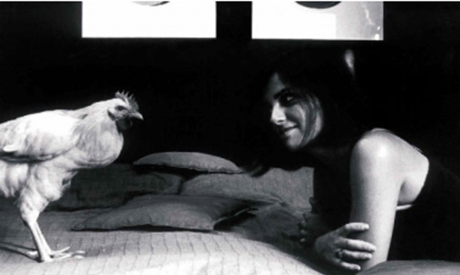
Produced in early 1970s,Nagy Shaker’s
experimental film “Sayf Sab‘een” (Summer 70), was one of the few Egyptian attempts in the realm of avant-garde cinema and is now regarded as one of the pioneering films in the field.
For that reason, the film was selected by New York’s Museum of Modern Art (MOMA) for its film archive, becoming the first Egyptian movie to receive such an honor.
Last November, Shaker’s film was screened in
MOMA under the three-year program
“Mapping Subjectivity: Experimentation in Arab Cinema, 1960s – Now,” organized by Jytte Jensen, the curator of the department of film in MOMA,
and Rasha Salti, artistic director of ArteEast. After touring various parts of the globe, the series has reached the Tate Modern in London this month.
he series presents an outlook on the chronological evolution of experimental film and video made in the Arab world from the 1960s until today.
Other Egyptian films included in the series include Maha Maamoun’s “Domestic Tourism II” (2009), and Shadi Abdel Salam’s classic feature “ The Mummy/Night of Counting the Years” (1973) and his short “El-Fallah El-Fasseeh” (The Eloquent Peasant, 1970).
Shaker was studying in Rome where he met Italian artist Paolo Isaja. Using an old 16mm camera, each artist alternated between directing, filming and recording. Together, they created the 70-minute black and white silent film.
“It was a time when youth culture was so active and
radical, as many decided to bail on the idea of money and became hippies.They wanted to change the world, although it was much better than now! We also choose to be rebellious but through our film,” explained Shaker at a lecture held in Helwan University in December following a film screening.
Read Full Article:
http://cultilax.blogspot.com/2011/07/moma-celebrates-nagy-shakers-film.html