MARIAM ELIAS, TUESDAY 13 MAR 2012
The Agreement, Hassan Khan’s new bilingual publication, follows his solo exhibition titled The Twist held in September at Objective Exhibitions in Antwerp, Belgium.
Rather than introducing his new book in a gallery space or museum, Khan probed new territory by launching his artistic publication in Al-Kotob Khan bookshop, turning the place into a juncture where various creators, such as prominent filmmakers, bloggers, writers, artists, curators and designers meet.
The evening opened with a presentation by Bassam El-Baroni, the director of Alexandria Contemporary Arts Forum and curator of the publication Fifteen Ways to Leave Badiou in which he invites critical theorist Suhail Malik with fifteen artists to produce a text and artworks responding to Alain Badiou’s piece Fifteen Theses on Contemporary Art.
Later Hassan Khan, along with writer Haythem El-Wardani and May Abo El-Dahb, director of the art space Objectif Exhibitions, started an engaging panel discussion about Khan’s latest publication and artistic project.
Through the narration of five short stories and the display of ten sculptural objects, artist, writer, and musician Khan explores new areas through which a colloquial language is built in its either lingual or textual form.
The stories don’t necessary have a dramatic climax, but rather moments of tension and distress where the reader finds himself in a private voyeuristic position with very unusual yet familiar characters.
Through meticulous description and vivid portrayals, the protagonists become recognisable.
The book opens with a portrait of Amal, a spinster who chose not to get married knowing that her birth defect and fortune might be an attraction for greed. She lives at her family’s building in Heliopolis with her veiled sisters-in-law and her two brothers, one of whom is an army officer.
The subject of another story is Haythem, a nineteen-year-old weed smoker, who is a Pink Floyd fan and a resident of a four storey apartment block with smoky dark glass windows in Madinet Nasr in Cairo.
An interdicted relationship of unrelated elements builds the sequence of each story. For example, Talaat ‘s recent promotion at the governor’s office will consequently make him able to replace his yellow Fiat 128 and boost his confidence in front his loser colleague in accounting, Fikry.
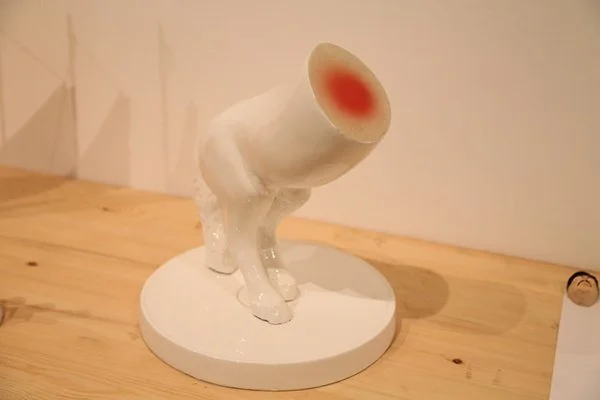
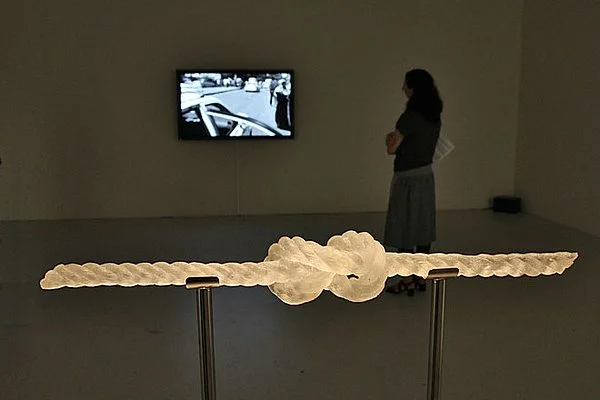
The stories are reassembled with an image of the croquet court at Heliopolis sporting club and photographs of ten sculptures with unusual titles, some of which use the names of characters from the stories. Despite this, the Haythem’s Dream glazed ceramic cylinder or the glass sculpture Fikry’s Soul and Hassan’s Tree do not directly symbolise or refer to the tales themselves.
Khan has chosen to purposely design kitsch objects and display them on a shelf in a contemporary art gallery under the title The Twist and later print a photographed version of them in a publication under the title The Agreement.
Read Full Article